Modern Slavery Statement
Australia 2025
We acknowledge the traditional custodians of the lands on which we live and work. We pay our respects to the Elders of these lands, both past and present, and extend that respect to all Aboriginal and Torres Strait Islander Peoples and First Nation Peoples globally.
This statement is made on behalf of Norton Rose Fulbright Australia (ABN 32 720 868 049) and Norton Rose Fulbright Australia Services Pty Ltd (ABN 51 091 227 486) pursuant to section 14 of the Modern Slavery Act 2018 (the Act) and constitutes our modern slavery statement for the financial year ended 30 June 2024 (Reporting Period). Where we refer to “NRFA’, “we”, “us”, “our” or the “firm” in this statement, it means Norton Rose Fulbright Australia, Norton Rose Fulbright Australia Services Pty Ltd and other entities owned or controlled by Norton Rose Fulbright Australia Services Pty Ltd, Norton Rose Fulbright Australia Group Pty Ltd or Norton Rose Fulbright Australia Holdings Pty Ltd as trustee for the equity partners of Norton Rose Fulbright Australia.
Our Business Principles of Quality, Unity and Integrity underpin our culture, the way we work and what we stand for. We value our people and are committed to maintaining an environment where individuals feel safe and respected.
This statement illustrates how we apply our Business Principles in practice, and reflects our continued public commitment to assess, prevent and address the risks of forced, compulsory, trafficked or child labour within our organisation and in our supply chains.
Our structure, operations and supply chains
We have offices across Australia, in Brisbane, Canberra, Melbourne, Newcastle, Perth and Sydney.
Norton Rose Fulbright Australia provides legal and advisory services to clients, while Norton Rose Fulbright Australia Services Pty Ltd provides ancillary services to support the activities of Norton Rose Fulbright Australia. Norton Rose Fulbright Australia Services Pty Ltd, Norton Rose Fulbright Australia Group Pty Ltd and Norton Rose Fulbright Australia Holdings Pty Ltd have a number of subsidiaries, which are non-trading and do not have employees.
During the Reporting Period, Norton Rose Fulbright Australia, Norton Rose Fulbright US LLP, Norton Rose Fulbright LLP, Norton Rose Fulbright Canada LLP and Norton Rose Fulbright South Africa Inc operated as separate legal entities and were members of Norton Rose Fulbright Verein, a Swiss verein. Norton Rose Fulbright Verein helps coordinate the activities of the members but does not itself engage in the practice of law or other business.
On 1 July 2025, Norton Rose Fulbright Australia became financially integrated with Norton Rose Fulbright LLP, a limited liability partnership registered in England and Wales. Norton Rose Fulbright Australia will move to a calendar year reporting cycle. As a result, Norton Rose Fulbright Australia’s next modern slavery statement will cover the reporting period 1 July 2025 to 31 December 2026.
During the Reporting Period, we also had associations or alliances with other organisations such as the law firms Jaramer Legal (in which we had a minority shareholding) in Australia and TNB & Partners in Indonesia. Jaramer Legal is Australia’s first national majority Indigenous-owned law firm that provides a broad suite of corporate and commercial legal services. TNB & Partners is a law firm based in Jakarta that provides legal services in corporate and commercial, banking and finance and dispute resolution.
Our principal activity is the provision of legal and advisory services to business enterprises, governments and other public sector organisations. We are focused on six key industry sectors:
- consumer markets;
- energy, infrastructure and resources;
- financial institutions;
- life sciences and healthcare;
- technology; and
- transport.
Our total head count is approximately 829 comprising 519 females and 310 males. Our workforce predominately comprises legal professionals, supported by embedded business services professionals in technology, finance, legal operations, payroll, administrative and HR teams. The majority of our workforce is engaged on an ongoing basis. We utilise a very small pool of contractors, casuals and external consultants. In addition to the National Employment Standards described further in point (c) in Annexure A of this Statement, staff salaries are reviewed annually against the local market data for their role, and the market data is provided by Mercer twice annually. For staff covered by an Award, they are paid above the minimum Award rate under the Legal Services Award.
Our suppliers include suppliers of IT and communications equipment and services; real estate and related services such as office cleaning and other facilities management services; food and beverages services, transport such as airlines and couriers; marketing such as merchandise suppliers and conference providers; office equipment and supplies; and professional services such as auditors, accountants, consultants, legal counsel, banks, insurers, recruitment agencies, education and training service providers and medical services providers. We also have some suppliers that provide legal or other services which are used by us in the provision of services to our clients, primarily barristers. Our suppliers are primarily domiciled in Australia, but also include global entities that supply Norton Rose Fulbright globally.
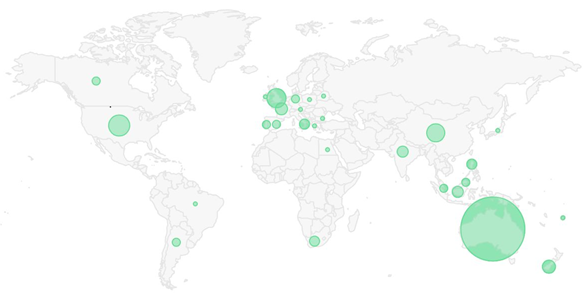
The geographic footprint representing where suppliers have business operations is shown below. It includes the locations in respect of the suppliers that completed our Modern Slavery Questionnaire (MSQ).
Modern slavery risks in our operations and supply chains
Our operations
As set out in the UN Guiding Principles on Business and Human Rights (UNGPs), business enterprises have a responsibility to respect internationally recognised human rights. The responsibility to respect human rights requires that business enterprises: (a) avoid causing or contributing to adverse human rights impacts through their own activities, and address such impacts when they occur; (b) seek to prevent or mitigate adverse human rights impacts that are directly linked to their operations, products or services by their business relationships, even if they have not contributed to those impacts.
In applying the lens of the UNGPs, we have assessed the potential for our operations to cause, contribute to, or be directly linked to adverse human rights impacts, including modern slavery. For the reasons described in this statement and summarised below, we remain of the view that there is low risk that our operations have caused or contributed to adverse human rights impacts:
- We follow set protocols in the way we recruit people into the firm via our recruitment practices. For example, we verify qualifications, conduct reference checking on prior experience, and verify the right to work in our country.
- We continue to monitor and engage with our staff on issues such as work hours and overtime, to ensure they are adequately compensated and we monitor excessive work patterns.
- We have policies and procedures to ensure that our workplace is free from discrimination based on gender, race, ethnicity, sexual orientation or any other status as set out in the Universal Declaration of Human Rights and other international human rights treaties and declarations.
For the reasons summarised below, we also remain of the view that the risk of our being directly linked to adverse human rights via our business partners in our operations is low:
- Given the nature of its services and the jurisdiction in which it operated, the level of risk of modern slavery in Jaramer Legal’s operations remained low.
- With respect to TNB & Partners, although Indonesia is a jurisdiction with a higher prevalence for, and vulnerability to, modern slavery in comparison to Australia, we do not consider our association with TNB & Partners links us to adverse human rights impacts. This is because of the nature of the professional legal services provided by TNB & Partners.
Supply chains
In applying the lens of the UNGPs, we have assessed the potential for our procurement activities to cause, contribute to, or be directly linked to adverse human rights impacts, including modern slavery. Given the nature of our procurement categories and practices as described in further detail below, it is unlikely that we have caused or contributed to modern slavery in our procurement of goods or services during the Reporting Period.
While our supply chain profile remains largely the same year-on-year, we list below the key categories of goods and services that we use in our business. We also provide a general description of the key modern slavery risks that are likely to exist in each of those categories by virtue of the industry risk profiles and provision of goods or services.
| Category | Inherent modern slavery risks1 |
| IT equipment and software | Forced labour and the worst forms of child labour are present in the supply chains that provide IT companies with the necessary raw materials to produce electronic goods, including parts. As reported in the 2024 report by the Bureau of International Labor Affairs (ILAB), the manufacture of electronics in China, Malaysia and Pakistan has also been associated with labour exploitation, including child labour and forced labour.2 The U.S. Department of Homeland Security’s (DHS) Uyghur Forced Labor Prevention Act Entity List includes several companies manufacturing general printing consumables and laser printers3. DHS includes the companies on the list on the basis that there are reasonable grounds to believe that the companies participate in business practices that target members of persecuted groups. |
| Cleaning services and facilities maintenance | The commercial cleaning industry is considered a higher risk industry for forced labour and debt bondage due to factors such as complex and opaque subcontracting arrangements and workers on temporary visas with limited bargaining power and awareness of their rights at work. The NSW Anti-slavery Commissioner’s Inherent Risk Identification Tool (IRIT)4 also classifies cleaning as having a high risk level, noting that vulnerability is heightened by factors such as dangerous work, low barriers to entry, a large proportion of temporary migrant workers and international students, limited English proficiency and wage theft. |
| Hospitality and food services | Food-related supply chains have a high risk of modern slavery, including forced labour, child labour and debt bondage due to the reliance on ingredients sourced globally, often from countries with a higher prevalence of, and vulnerability to, modern slavery. For example, coffee, tea, cocoa, rice, palm and derivative products and seafood are some of the many products linked to child and forced labour.5 The hospitality and food services industry, irrespective of jurisdiction, has elevated risks driven by parallel factors described above in relation to the cleaning sector. As noted in the IRIT for food catering and consumables, food production (including in Australia) often relies on migrant workers. These groups are vulnerable to exploitation in the horticulture, agriculture and meat processing industries due to language barriers, dependence on employers for visa sponsorship and limited access to support networks. |
| Corporate merchandise | Mass-produced items and garments, particularly if produced in countries with a greater prevalence of, and vulnerability to, modern slavery, have a higher risk of child labour and forced labour. Textiles, cotton and garments are listed in ILAB’s 2024 list of goods produced by child labour and forced labour. |
| Office fit-out materials and furnishings | There are increased modern slavery risks associated with producing and sourcing raw materials such as timber, bricks, PVC in flooring, fabrics, metals and glass as well as risks in the manufacturing industry located in countries with a greater prevalence of, and vulnerability to, modern slavery. |
| Travel services | Although global travel management services are typically the first-tier suppliers for large companies, hotels and airlines and their contracted and labour hire workers providing base-skilled labour inevitably form part of the supply chain for purchasers of travel services. A vulnerable workforce supporting these industries combined with complex supply chains contribute to increased modern slavery risks. |
| Postal and courier pick-up and delivery services | The prevalence of subcontracting and labour hire places the suppliers in this category at greater risk of being directly linked to modern slavery. The delivery services industry, irrespective of jurisdiction, has elevated risks driven by parallel factors described above in relation to the cleaning sector. |
Based on the information gathered via our modern slavery questionnaire, our suppliers manufactured or procured goods and/or services from a range of countries including Australia, the United States, the United Kingdom, France, Singapore, China, Indonesia, South Africa and India. Of these countries, the Fund for Peace Fragile States Index Annual Report 2024 scored China 9.4 out of 10 and India 7.6 out of 10 for human rights and the rule of law.6
Although these figures are not direct measurements of the prevalence of modern slavery, they provide insights into the conditions in which adverse human rights impacts, including modern slavery, can exist.
Of the suppliers that completed the questionnaire during the Reporting Period, approximately 27 per cent received an overall moderate risk rating for modern slavery and 73 per cent received an overall low risk. No suppliers received a high risk rating. Those that received a moderate risk rating were mainly suppliers operating in the food and hospitality sector, including event spaces, and the information media and telecommunication sector.
_____________________________
1. The risks outlines in this table are general and do not relate to any actual instances of modern slavery in the supply chain of our first-tier suppliers.2.https://www.dol.gov/agencies/ilab/reports/child-labor/list-of-goods-print3. Appendix B, https://www.dhs.gov/sites/default/files/2025-08/25_0819_plcy_uflpa-strategy-2025-update-508.pdf.Entities that supply printer consumables to NRFA are on this list.4.https://dcj.nsw.gov.au/legal-and-justice/our-commissioners/anti-slavery-commissioner/due-diligence-and-reporting.html#%3Cb%3EGRS4
5. https://www.dol.gov/sites/dolgov/files/ILAB/child_labor_reports/tda2021/2022-TVPRA-List-of-Goods-v3.pdf6. Fund for Peace (FFP), ‘Fragile States Index Global Data 2024’ < https://fragilestatesindex.org/global-data/>. Note that the lower the score, the better ranked the country is based on FFP’s scoring methodology.
Due diligence process and steps taken to assess and manage modern slavery risk
As a provider of legal services, a purchaser of goods and services and also an employer, we recognise our responsibility under the UNGPs to respect human rights in all areas of our practice. Accordingly, we continue to assess and adopt measures to mitigate modern slavery risks across three levels of our business, namely, operations, client services and supply chain. Our existing policies and procedures are set out in Annexure A. During the Reporting Period, the policies and procedures were operational.
Our operations
During the Reporting Period, we continued to implement measures to mitigate against modern slavery risks. An overview of the actions we have taken to assess and manage modern slavery is set out below, in addition to the ongoing measures we have in place as set out in Annexure A:
- We continued to monitor the reports made via our whistleblowing channels and confirm that we did not receive any reports of actual or suspected violations of our Human Rights Policy or which otherwise gave rise to cause for concern relating to human rights during the Reporting Period.
- A new modern slavery training module which was developed by our business and human rights subject matter experts was released to all staff as part of our compulsory training program. The updates included an overview of the red flags for modern slavery, why it matters to us and our policies and controls to mitigate modern slavery. Approximately 84 per cent of staff required to complete the module had satisfied the training requirement by the end of the Reporting Period.
Client services
As stated in our Human Rights Policy, we continue to assess potential human rights impacts and consider these when opening new client matters. All new clients are subject to checks that identify any high-risk industries in which they operate. We review clients’ annual reports where available, conduct internet searches and use a subscription database to identify financial crime convictions and adverse media reports. If a client’s industry is regarded as high-risk for human rights issues, our searches are more extensive.
During the Reporting Period, the Client Due Diligence (CDD) checks performed by our Compliance team did not identify circumstances warranting escalation based on actual or suspected adverse human rights impacts.
Our General Counsel team continued to monitor the responses to our internal monthly email seeking disclosure of any circumstance of breach of our Human Rights Policy, as well as any cause for concern relating to human rights in any part of our supply chain. Our partners and senior lawyers have not raised human rights issues in relation to our client services (or our supply chain) during the Reporting Period.
Through our advisory work and the sharing of best practice between our Business Human Rights team, Environmental, Social and Governance team and our other practice areas, we have continued to support our clients’ understanding of human rights issues and impacts, including modern slavery.
Our Business Human Rights subject matter experts have presented at numerous roundtables and webinars for clients and external audiences in relation to modern slavery, human rights due diligence and best practice. During the Reporting Period, we held a webinar for financial institutions on the human rights toolkit published by the United Nations Environment Programme.
We have also published articles and legal updates where we explain various regulatory developments (see link here). This education role is part of our commitment to improve the understanding of the responsibility of business to respect human rights.
In addition to our ongoing efforts to raise awareness of modern slavery risks, many of our clients have sought our participation in their supply chain due diligence efforts. During the Reporting Period, we continued to cooperate with the risk assessment measures requested by our clients as and when required. In recognition that we form part of supply chains of other reporting entities, we responded to modern slavery questionnaires issued to us by our clients and when engaging with clients on new matters we provided details of our human rights due diligence and other information regarding our modern slavery risk profile.
Pro bono practice
Through the human rights pillar of our pro bono strategy, we have undertaken pro bono projects supporting the protection of human rights and prevention of modern slavery. In addition to providing secondees to Anti-Slavery Australia and the Immigration Advice and Rights centre, our pro bono engagements have included:
- Continuing to work with the Clean Energy Council (CEC) in relation to its Modern Slavery Working Group in facilitating the mitigation of modern slavery in the renewable energy value chain.
- Drafted a white paper with the Commonwealth Anti-slavery Commissioner in relation the EU introduction of a corporate human rights due diligence obligation. We also hosted a webinar with the Commissioner to discuss the implications of the EU regulations on Australian businesses.
- Undertaking a research project for a human rights organisation and advising on the due diligence requirements in modern slavery laws.
- Continuing to assist clients in relation to alleged modern slavery claims.
Supply chain
Our core procurement processes for assessing and managing modern slavery and human rights impacts have remained stable for a number of years. We continued to use the MSQ on the Ethixbase360 platform as a key part of our modern slavery due diligence program. We monitor staff changes and provide training on the platform at appropriate intervals.
In summary, our due diligence process involved:
- The consideration of the human rights impacts of a supplier’s provision of goods or services to us both at the time of first selecting the supplier and upon renewal or extension of the contract with the supplier.
- All material suppliers to confirm in writing their compliance with our Supplier Charter or an equivalent document (for example, the supplier’s own supplier charter) that is approved by our General Counsel. Our Supplier Charter sets out our expectations of suppliers in respect of anti-bribery and corruption, diversity and inclusion, health and safety, sustainability and human rights. In respect of human rights, it provides that our suppliers, whether directly or through their supply chain, must comply with all applicable human rights related laws in respect of their employees; conduct their business activities in a manner which respects human rights as set out in the Universal Declaration of Human Rights and the core conventions of the International Labour Organization; not hold another person in slavery or servitude, employ, engage or otherwise use forced or compulsory labour, trafficked labour or child labour; and not engage in or condone the use of corporal punishments or mentally, physically or sexually abusive or inhumane treatment of workers.
- That suppliers meeting our internal procurement annualised spend threshold, and all suppliers providing goods and/or services relating to courier services, food and food-related goods and services and/or cleaning services, complete the online MSQ.
Assessing the effectiveness of our actions
We continue to assess the effectiveness of our actions by reference to the goals we set for the next reporting period and tracking our progress against those goals. We will continue to review, monitor and embed our processes by progressing the following goal.
We will continue to review, monitor and embed our processes by progressing the following goals:
| Goal for 2025 | FY25 progress and next steps FY26 |
| Monitor supplier responses to our question on compliance with our Supplier Charter. | Monitor supplier responses to our question on compliance with our Supplier Charter. All suppliers who completed the MSQ during the Reporting Period agreed to comply with our Supplier Charter. Where we identify potential risks in the supply chains of our direct suppliers, we will engage with them on those risks and assess their level of understanding of our Supplier Charter. |
| Review the MSQ results from 2025 and assess the need to conduct any additional deep dives. | We assessed the results of the MSQ from 2025 and considered the suppliers of IT hardware during FY25 given the heightened risks of modern slavery in the supply chain of IT hardware inputs. All three suppliers of IT hardware to Norton Rose Fulbright Australia during FY25 had completed the MSQ and received low or moderate risk ratings. We will continue to review the MSQ results and our suppliers of goods and services in higher risk categories and assess the need to conduct any additional deep dives. |
| Monitor the reporting channels for any reported instances of human rights impacts in our operations and supply chains. | We monitored the reports via the reporting channels and did not receive reports relating to modern slavery during FY25. We will continue to monitor our reporting channels for any concerns raised relating to adverse human rights impacts, including modern slavery. |
| Provide mandatory training for staff with a procurement function to properly apply our Supplier Contracts Policy and in respect of the use of the Ethixbase360 platform to conduct modern slavery due diligence on new suppliers. | During the Reporting Period, we provided training on our Supplier Contracts Policy and the Ethixbase360 platform to staff with a procurement function. We also provided ad hoc support and guidance to staff with a procurement function. We will continue to monitor staff changes and provide bespoke training for those with a procurement function at appropriate intervals during FY26. |
| Analyse the results of the review of data of payments paid to suppliers as against suppliers uploaded to the Ethixbase360 platform to identify where there are process gaps resulting in suppliers bypassing the MSQ requirement. | We conducted an assurance process as described earlier in this statement. We will continue to perform this reconciliation process annually. |
| Update the training content on our whistleblowing policy and roll it out to staff in FY25. | We rolled out updated training content during the Reporting Period. |
Other information
Engagement in the business and human rights community
We remain committed to the sharing and dissemination of our knowledge and expertise in the area of business and human rights in order to promote capacity building amongst our clients as well as more widely in the market.
One of our consultants, Greg Vickery AO, sits on the Expert Advisory Committee set up by the Attorney-General’s Department to provide expert advice to government on the operation of the Act, as well as strengthening compliance with the Act. Abigail McGregor and Greg Vickery AO are members of the Law Council of Australia’s Business and Human Rights Committee (which Greg chairs) and the Foreign Corrupt Practices Working Group.
NRFA is a member of the Australian Business and Human Rights Law Association which meets periodically to discuss collaboration opportunities. Members of our Business Human Rights group attended events and meetings during the Reporting Period.
Our sustainability approach
In 2025, Norton Rose Fulbright Australia became a member of the United Nations Global Compact Network Australia, a network that brings together Australian businesses and organisations and empowers them to act responsibly and sustainably. Members must align their organisational strategy and operations with the Ten Principles on human rights, labour, environment and anti-corruption.
Norton Rose Fulbright LLP (with respect to its business in Europe, Middle East and Asia) published its annual Responsible Business Report in relation to progress from 2024 and outlining Norton Rose Fulbright’s global initiatives, policies and goals.
Consultation and approval
This statement was prepared by our General Counsel team and our modern slavery subject matter experts, who have consulted with partners, directors, employees and contractors (as applicable) of both Norton Rose Fulbright Australia and Norton Rose Fulbright Australia Services Pty Ltd. The Australian Valve Committee of Norton Rose Fulbright Australia (which since 1 July 2025 has become the principal governing body of Norton Rose Fulbright Australia) approved this statement on behalf of the partners of Norton Rose Fulbright Australia on 11 December 2025, and the board of directors of Norton Rose Fulbright Australia Services Pty Ltd approved this statement on 4 December 2025. Annexure B sets out the page references within this statement addressing the mandatory reporting criteria. Annexure B sets out the page references within this statement addressing the mandatory reporting criteria.
Alison Deitz
Australia Country Head
Norton Rose Fulbright Australia
Alison Deitz
Director
Norton Rose Fulbright Australia Services Pty Ltd
Annexure A
| Existing policy or procedure | |
| a) | All partners and staff are expected to comply with our Business Principles of Quality, Unity and Integrity as well as any relevant laws and professional codes of conduct applicable to us. These ethical principles are embedded in employment contracts and supported by our policies as set out in our intranet, and are communicated to new employees on commencement. |
| b) | Our Human Rights Policy articulates our commitment to respecting internationally recognised human rights under the UN Guiding Principles, the International Bill of Human Rights and the ILO Declaration. It also sets out our expectations for the conduct of our business partners. |
| c) | We recognise that one of the fundamental human rights is the right to an adequate living wage. Norton Rose Fulbright Australia provides at least the minimum entitlements called the National Employment Standards to all its full-time and part-time employees. For those employed under the Legal Services Award 2020, we ensure compliance with the minimum pay and conditions as set out in the award. We comply with the minimum wage standards applicable to each of our offices and there is a regular process in place to monitor compliance. |
| d) | We have an established remuneration framework which is designed to ensure our people are paid fairly, competitively and based on merit. Our remuneration framework is structured to reward people for their individual and collective contribution to our success, for demonstrating our values and for creating value for the firm, our clients and stakeholders. |
| e) | In our efforts to address the human rights risk of excessive working hours, our People and Development team reviews excessive hours and overtime hours and, along with their supervisor or manager, provides any necessary support to employees to manage their workload. |
| f) | We recognise that diversity and inclusion is a critical business issue. We aim to leverage the rich diversity of our people in order to provide better service to our clients now and into the future. We value difference and the variety of perspectives this brings to the firm. We have a well-developed diversity, equity and inclusion policy and program – and promote a diverse workforce and an inclusive culture. |
| g) | The right to feel safe in our workplaces is another enshrined human right. We take a zero-tolerance approach to sexual harassment and indeed any form of harassment, discrimination or bullying. Our policies reflect this stance and every member of our firm has the right to feel respected and safe. Our policies relating to equal employment opportunity (EEO), discrimination and harassment, psychosocial safety and Appropriate Workplace Conduct and Issues and Complaints Resolution Procedure are some of the documents that ensure our staff understand the workplace conduct expected of them and the procedures available to seek support. These policies are supported by a mandatory e-learning module, Respect@Work, covering a variety of topics such as discrimination, harassment, bullying, sexual harassment and other inappropriate behaviour. |
| h) | Our client and matter induction process is extensive and takes potential risks relating to human rights into consideration. Compliance officers, including those in our Australian Client Due Diligence (CDD) team, have been trained to extend their Know Your Client (KYC) screening to include the human rights record of, among other things, the client, counterparties and any relevant jurisdiction(s). |
| i) | The Modern Slavery Questionnaire (MSQ) was developed by our Business Human Rights group in 2018 to promote more ethically sustainable sourcing practices and to streamline the process of assessing modern slavery risk in our own supply chain. It is a cloud-based solution that brought together powerful analytics, our global human rights expertise and user-friendly design to identify and manage supply chain risk. Through the MSQ process, suppliers are allocated a modern slavery risk rating which then provides the groundwork for informing the actions to be taken. In July 2020, the MSQ was licensed to Ethixbase. |
| j) | Our Supplier Charter sets out our expectations of suppliers in respect of anti-bribery and corruption, diversity and inclusion, health and safety, sustainability and human rights. All our material suppliers are required to confirm in writing their compliance with our Supplier Charter or an equivalent document. |
| k) | Prospective employees are vetted for rights to work in Australia, and we collect Visa/passport details during onboarding. |
Annexure B
| Mandatory criteria | Page number/s | |
| a) | Identify the reporting entity. | 1 |
| b) | Describe the reporting entity's structure, operations and supply chains. | 3-4 |
| c) | Describe the risks of modern slavery practices in the operations and supply chains of the reporting entity and any entities it owns or controls. | 5-7 |
| d) | Describe the actions taken by the reporting entity and any entities it owns or controls to assess and address these risks, including due diligence and remediation processes. | 8-9 |
| e) | Describe how the reporting entity assesses the effectiveness of these actions. | 10 |
| f) | Describe the process of consultation on the development of the statement with any entities the reporting entity owns or controls (a joint statement must also describe consultation with the entity covered by the statement). | 12 |
Download the Norton Rose Fulbright Australia Modern Slavery Statement 2025