Snapshot
The world of corporate sustainability is one of the most complex and divergent areas of regulation across the globe. In 2025, previously observable trends toward greater regulation in this sphere faltered and, in some regions, reversed. In 2026, it is unlikely that any “new normal” will emerge and corporates and financial institutions will continue to be presented with a varied and potentially incoherent mixture of policy and regulatory prescriptions globally in response to nature-related risk.
Notwithstanding the shifting policy landscape, the recognition that climate change and nature loss are inextricably linked together with an increased understanding of the global economy’s impact and reliance on nature, continues to grow.
This has resulted in the steady evolution of climate and nature-related disclosures and directors’ duties in respect of climate and nature-related financial risks.
In this article we focus on the developments impacting the evolution of directors’ duties in respect of nature, including the impact of four legal opinions, from New Zealand, Australia, the UK and Canada. Each of these opinions have concluded that, under existing corporate law, directors are under a positive obligation to identify, assess and manage material nature-related risks.
We also provide an overview of some developments from other jurisdictions and provide practical recommendations for boards.
Background and introduction
The global economy is inextricably linked to the health of natural systems.1 More than half of global GDP is moderately or highly dependent on nature, with sectors such as forestry, agriculture, mining, and energy facing particularly acute exposure to nature-related risks.2 The World Economic Forum's 2026 Global Risks Report identifies ‘biodiversity loss and ecosystem collapse’ and ‘natural resources shortages’ as among the most significant threats to economic stability over the next decade.3
This is underscored by central bank research, including from the European Central Bank, which has found that nearly 75 percent of European corporate bank loans are exposed to moderate or high biodiversity risk.4 These findings highlight the systemic and pervasive nature of nature-related risks across the financial system.
Since the adoption of the Kunming-Montreal Global Biodiversity Framework (Kunming Protocol) and its Target 15, which calls for mandatory corporate disclosure of nature-related dependencies and impacts, there has been a marked shift in legal thinking.5 Four high profile legal opinions – Chapman Tripp (New Zealand, 2023), Hartford-Davis & Bush (Australia, 2023), Shivji & Stubbs (UK, 2024), and DeMarco & Vollmer (Canada, 2025) – have each concluded that, under existing corporate law, directors are under a positive obligation to identify, assess and manage material nature-related risks. These duties arise not only under the duty of care, diligence, and skill, but also under the fiduciary duties of loyalty and good faith. The convergence of these opinions signals an emerging legal consensus that nature-related risks are now a core component of directors’ responsibilities.
Regulatory and market developments are increasingly driving the integration of nature-related risk into corporate governance. Frameworks such as the Kunming Protocol and the Taskforce on Nature-related Financial Disclosures (TNFD) are enhancing the availability and quality of information for boards, investors, and lenders. However, the pace and direction of regulatory and policy change remains inconsistent across jurisdictions. In some regions – notably, North America and Europe – legislators, policy makers and corporate leaders are being forced to reconsider the scope of disclosure and due diligence requirements in increasingly polarised geopolitical and domestic political environments. This creates a complex and, at times, contradictory regulatory environment, requiring boards to navigate both changing expectations and regulatory uncertainty.
Against this backdrop, directors who fail to address nature-related risks expose themselves to claims and their companies to litigation, regulatory and reputational risk.
This article builds on the four legal opinions and is structured in three parts: (I) a summary of the opinions and their implications for directors’ duties; (II) an analysis of the evolving regulatory and market environment; and (III) practical recommendations for boards.
Part I: Directors’ duties and nature-related risk
The below summary is intended as an introduction to the relevant concepts that arise when navigating nature-related risk as it relates to directors’ duties in light of the four legal opinions. It is not intended to provide detailed or jurisdiction-specific analysis.
The duty of care, diligence and skill
The four legal opinions from New Zealand, Australia, the UK and Canada conclude that nature-related risks are foreseeable now and fall squarely within the scope of directors’ duty of care, diligence and skill (referred to as the duty of care and diligence in the Australian Corporations Act 2001 (Cth)).6
Nature-related risks are highly context-dependent but can be broadly categorised as follows:
- Physical risks: These encompass the direct impacts of nature loss, including the degradation of ecosystem services (such as pollination, water purification, and soil fertility), depletion of natural capital and the increased frequency or severity of extreme weather events. The scientific and economic literature provides robust evidence of these risks and their capacity to disrupt business operations and supply chains.
- Transition risks: These stem from shifts in the regulatory, legal and market landscape. They include the introduction or tightening of environmental laws, mandatory disclosure and due diligence requirements, the emergence of new industry standards (such as those promulgated by the TNFD), evolving investor and consumer expectations, reputational risks, and the potential for strategic litigation.
The duty of care, diligence and skill applicable to directors is assessed against an objective standard. The standard is therefore dynamic and shaped by evolving expectations in corporate governance, particularly as nature-related risks gain prominence in investor and regulatory agendas.7
The opinions underscore the necessity for boards to actively gather, scrutinise and interrogate information on nature-related risks relevant to their organisations.8 This may involve seeking advice and ensuring that the board develops and maintains appropriate knowledge. Directors who remain uninformed or under-informed about material nature-related risks significantly increase their exposure to claims of breach of the duty.9
The opinions highlight that material financial risks arising from nature loss are frequently intertwined with a company’s own impacts on nature and that such impacts can become financially material over time as a result of regulatory, market or physical developments.10 These manifestations of financial risk to an organisation can be sudden or gradual, acute or cumulative.
Duties of loyalty and good faith
Directors are also bound by the fiduciary duties of loyalty or the obligation to act in good faith and in the best interests of the company.11 The duties of loyalty and good faith are measured against a subjective standard and ask what the director’s motivations were in the given circumstance. UK law applies an objective standard to the duty where a director fails to give any consideration as to whether an action is in the best interests of the company or fails to consider a “very material interest.”12
In the UK and Canada, corporate statutes explicitly require directors to consider the environmental impacts of the company’s operations, consistent with an ‘enlightened shareholder value’ approach to corporate governance.13 Such considerations are subordinate to the interests of the company but can be weighed by a director when discharging their fiduciary duties.
The UK, Canadian and New Zealand opinions concur that nature-related risks are directly relevant to the duty of loyalty and good faith, given their potential to materially affect a company’s financial performance and long-term sustainability.14
While the duty does not mandate that directors prioritise nature-related risks above all other considerations, it can require a rational and informed balancing of material risks in the best interests of the company.15 In certain circumstances, it may be appropriate for directors to prioritise minimising adverse impacts on nature where this aligns with the company's long-term interests.16
At a minimum, directors must undertake a rational, well-documented, and informed process to identify and assess nature-related risks.17 Failure to do so may expose directors to claims for breach.
Part II: Nature-related risk in an unstable environment
Changes in the information landscape
Directors face significant challenges in identifying and assessing nature-related risks stemming from a company’s impact on nature, largely due to the absence of a universal metric comparable to CO₂ emissions in the context of climate risk. Nature-related dependencies and impacts are also highly specific to geography, ecosystems, and business models, which complicates measurement and benchmarking.18 Nevertheless, the information environment is evolving rapidly, with new frameworks and data sources emerging to support more robust risk assessment by firms, lenders and investors.
Target 15 of the Kunming Protocol obliges signatories to implement legal, administrative or policy measures that encourage and enable businesses to monitor, assess, and transparently disclose their risks, dependencies, and impacts on biodiversity.19 This has catalysed the development and adoption of frameworks such as the TNFD, which had over 740 organisations globally representing US$20 trillion in assets under management committed to its recommendations as of September 2025.20
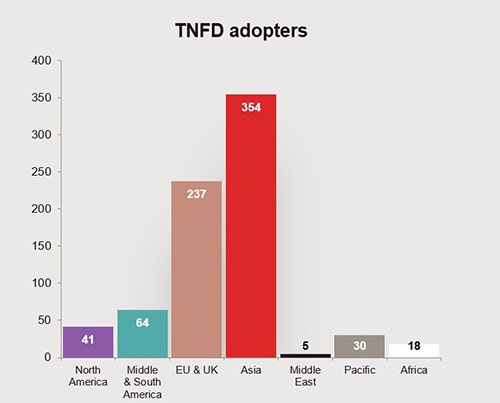
Regional breakdown of TNFD adopters21
Additional standards, including the Global Reporting Initiative (GRI) for biodiversity and the Science Based Targets Network (SBTN) for nature, are also gaining significant traction.22
An initial inquiry for boards has been to understand the extent to which decision-useful information on nature-related risk is available to them. At present, the picture that emerges is one of high-volume and low definition. In mid-2025, the TNFD published a comprehensive evidence review on nature-related financial risks and a supporting database comprising over 300 entries based on 360 sources of information, spanning 17 ‘physical’, five ‘transition’ and six ‘systemic’ risks, including studies on exposure to nature risks.23 The studies included pollination decline, soil degradation, ecosystem services collapse and ecosystem stability and spanned sector-specific and economy-wide data. The authors of the TNFD Evidence Review concluded there is “extensive evidence” to demonstrate that information on nature-related risks is increasingly important to investors and that omitting, misstating or obscuring such information could reasonably be expected to influence investors’ decisions.24
Gathering and translating information on nature-related risks remains challenging for corporates and financial institutions. Limited corporate disclosures on nature-related financial risks and the absence of a single accepted indicator or metric makes it difficult to estimate financial materiality at the entity or portfolio level.25 Whilst the awareness of nature-related risks has trended up, a gap has emerged between the perception of risk by corporates and financial institutions and effective measurement. For example, the Global Association of Risk Professionals (GARP) released its survey on nature risk management in 2025 reporting that 42 percent of the financial institutions interviewed have identified nature-related risks or opportunities, an increase from 25 percent in 2024.26 GARP identified that despite an increase in the perception of nature-related risk, most firms had not assessed whether their current strategy was resilient to nature-related risks.
A similar picture has emerged in the investor community. A global survey of Norges Bank Investment Management investee companies in 2025 focused on nature-related risk perceptions and found that 44 percent of companies interviewed consider that nature-related physical risks have financial effects “already today” and 27 percent for transition risks.27 However, less than a quarter considered that investors assessed how these risks affect a company’s forecast cashflows or costs of capital, suggesting that investor interest in nature-related risk has not translated into traditional financial analysis frameworks.28 Furthermore, company-specific evidence on nature-related risk is less extensive than macroeconomic data, particularly in the academic literature, mainly due to reliance of these studies on publicly available data.29
Amidst this perceived information deficit, the technical path to implementing standardised assessment and reporting of nature-related risks and opportunities appears to be progressing. The International Sustainability Standards Board announced in November 2025 that it would draw on the TNFD framework and undertake standard-setting to introduce incremental requirements on nature-related risks and opportunities not already reflected in IFRS S1 General Requirements for Disclosure of Sustainability-related Financial Information and IFRS S2 Climate-related Disclosures.30
The continued growth in publicly available data and analysis on nature-related financial risk and strong support for voluntary disclosure regimes globally suggests that the case for foreseeability is compelling and investor expectations will continue to drive demand for such information. Despite significant gaps in the available data on nature-related risk at the company level, directors that fail to identify and assess relevant sources of information in the public domain and through their own initiatives, run the risk of depriving boards and investors of decision-useful information and exposing themselves to claims if that information relates to foreseeable and material nature-related risks.
Regional divergence and political polarisation
Since the publication of the first legal opinion in 2023, the pace and direction of regulatory change regarding nature-related risk has been far from uniform. In Europe, the ‘EU Omnibus Simplification Package’ (Omnibus Package) tabled in February 2025 and approved by the European Parliament in December 2025 significantly curtails the scope and detail of sustainability reporting and environmental due diligence obligations under the Corporate Sustainability Reporting Directive (CSRD) and the Corporate Sustainability Due Diligence Directive (CS3D).31
The original Omnibus Package estimated that some 80 percent of companies would be taken out of the scope of the CSRD and CS3D. The package approved by the European Parliament further reduces the scope of both directives by increasing various revenue and employee thresholds for EU and non-EU companies.32 As part of the Omnibus Package, European Financial Reporting Advisory Group (EFRAG) submitted technical advice to the European Commission (EC) in December 2025 that proposed substantial reductions to the number of mandatory data points required to be reported against by businesses under a simplified European Sustainability Reporting Standard (ESRS).33
The draft simplified ESRS maintains the existing standards for climate change, pollution, water, biodiversity and ecosystems and resource use together with the concept of ‘double materiality’. This principle requires companies to disclose both financially material sustainability-related risks and opportunities to the entity (financial materiality) and material impacts of the entity on people and the environment (impact materiality) over the short, medium or long term.34 The adoption of amendments to the ESRS are anticipated in mid-2026 following consultation with the EC.
In the United States, an ‘ESG backlash’ continues to unfold, with nature-positive and net-zero initiatives potentially imperiled. Several major banks withdrew from the Net Zero Banking Alliance between December 2024 and January 2025 and the Federal Reserve has exited the Network of Central Banks for Greening the Financial System.35 Executive Orders and memoranda issued by the US administration in 2025 and 2026 have signaled the removal of the US from multilateral agreements and organisations including the Paris Agreement, the UN Framework Convention on Climate Change and the Intergovernmental Science-Policy Platform on Biodiversity and Ecosystem Services.36 A 2025 global study found that North American asset managers are operating under some of the weakest governance frameworks for responsible finance, particularly in relation to biodiversity risk.37 This trend could have flow-on effects for companies operating within the US and globally if geopolitical pressure and policy transmission lead to shifts in consensus elsewhere.
For companies and financial institutions operating in changing regulatory environments, while reduced nature-related disclosure and due diligence requirements may alter the form and timing of transition risk, they do not eliminate the underlying physical risks. In some cases, diminished transparency may heighten physical and systemic risks by creating blind spots in companies’ operations or supply chains.38 Companies operating in jurisdictions where environmental controls, sustainability reporting and due diligence requirements are in retreat or rudimentary may be less exposed to immediate transition risks but in the long run more exposed to sudden shocks in the form of supply chain disruptions, capital loss and reduced access to finance.
Part III: Practical steps for boards
Given the complexities and uncertainties inherent in understanding nature-related risks, boards should adopt a proactive and structured approach to governance that looks beyond the immediate demands of regulatory settings and policy prescriptions.
It is therefore recommended that boards:
- Proactively integrate nature-risk identification and assessment into governance and risk management processes.
- Maintain ongoing vigilance over legal, regulatory, and market developments at both domestic and international levels.
- Ensure that the board possesses, or has access to, the necessary expertise and resources to respond effectively to evolving expectations and regulatory requirements.
Care should be exercised to ensure that the lack of regulatory certainty or information scarcity does not lead to inertia. The four legal opinions surveyed offer a roadmap for directors to follow in meeting their legal and fiduciary obligations.
These actions could include:
A. Identify and assess nature-related risks
- Directors should actively identify nature-related risks across both the short and long term, taking into account the company's dependencies and impacts on nature, irrespective of current disclosure obligations.
- Employ established tools such as the TNFD ‘LEAP’ approach or SBTN target-setting process to map and prioritise material impact drivers (land use change, resource exploitation, invasive species and pollution) within the company’s operations and supply chains.
- Evaluate both the immediate and long-term financial materiality of these risks, recognising that impacts on nature can become financially material over time as a result of regulatory, market, or physical developments.
B. Monitoring and trend analysis
- Ensure that in-house teams or external advisers are engaged to monitor domestic and international developments, including changes to sustainability reporting and due diligence requirements and legislative reforms affecting ecosystem services, biodiversity, and natural capital.
- Continuously monitor and evaluate sectoral studies, risk assessments from central banks, prudential institutions, and industry bodies to ensure the board remains informed by the latest research and perspectives.
C. Build competence and capacity
- Boards should ensure that directors possess the requisite sectoral, specialist and management expertise to address nature-related risks. Any gaps should be addressed through targeted training or the engagement of external advisers, as appropriate.
- Map internal resources to support the board’s information needs and ensure that any expert advice obtained is properly documented, including the scope of work, assumptions, and limitations to demonstrate reasoned reliance on that advice.
Conclusion
The scientific, economic and legal consensus is that nature loss constitutes a foreseeable and material business risk. Directors who fail to identify, assess and manage nature-related risks are increasingly exposed to the risk of breaching their duties.
Although the regulatory landscape remains uneven and subject to change in highly polarised geopolitical and domestic political environments, the prevailing trend remains toward greater integration of nature-related risk into corporate governance and disclosure. Boards should not allow regulatory uncertainty or inconsistent global approaches to nature-related risks and opportunities to serve as a justification for inaction. Proactive governance, informed by the latest legal, scientific and market developments is essential to safeguarding the long-term interests of companies.
(This article is current as at the publication date and is not legal advice.)
Footnotes
-
Dasgupta, S.P. (2021) Final Report – The Economics of Biodiversity: The Dasgupta Review.
-
World Economic Forum (2020) Nature Risk Rising: Why the Crisis Engulfing Nature Matters for Business and the Economy.
-
World Economic Forum (2026) The Global Risks Report 2026.
-
Boldrini, S. et al. (2023) Living in a world of disappearing nature: physical risk and the implications for financial stability. 333.\
-
CBD/COP/DEC/15/4 (19 December 2022) Decision adopted by the Conference of the Parties to the Convention on Biological Diversity, Annex [4]. Target 15 of the Kunming Protocol requires signatories to take “legal, administrative or policy measures to encourage and enable business… [to] monitor, assess and transparently disclose their risks, dependencies and impacts on biodiversity.”
-
Chapman Tripp at [3].
-
Shivji & Stubbs at [69], [72]-[73]; DeMarco & Vollmer at [117].
-
DeMarco & Vollmer at [109]; Chapman Tripp at [63]; Hartford-Davis & Bush at [10], [16]-[32]; Shivji & Stubbs at [74]-[76].
-
Hartford-Davis & Bush at [41]; Chapman Tripp at [63];
-
DeMarco Vollmer Opinion at [158], [170].
-
Corporations Act 2001 (Cth) s 181; Companies Act 1993 (NZ) s 131; Companies Act 2006 (UK) s 172; Canada Business Corporations Act, R.S.C., 1985, C-44 (Can) s 122(1)(a).
-
Shivji & Stubbs at [66].
-
Companies Act 2006 (UK) s 172(1); Canada Business Corporations Act, R.S.C., 1985, C-44 (Can) s 122(1.1); Shivji & Stubbs at [89]; DeMarco & Vollmer at [89]-[97].
-
DeMarco & Vollmer at [99]; Shivji & Stubbs at [83]-[84]; Chapman Tripp at [67]. Hartford-Davis & Bush did not consider the duty in s 181 of the Corporations Act 2001 (Cth) to act in good faith in the best interests of the corporation and for a proper purpose.
-
DeMarco & Vollmer at [104]
-
Shivji & Stubbs at [96]-[97]
-
DeMarco & Vollmer at [105]; Shivji & Stubbs at [99]-[101]
-
Hartford-Davis & Bush at [25]-[32]; DeMarco & Vollmer at [32], [109], [163], [197]; Shivji & Stubbs at [51], [62]
-
Kunming Protocol, Annex [13], Target 15 (Section H.1 – Targets for 2030).
-
TNFD (September 2025), TNFD 2025 Status Report.
-
Table is accurate as of 23 January 2026 (Source: TNFD Adopters – TNFD).
-
GRI Topic Standard for Biodiversity (accessed on 19 September 2025).
-
TNFD (June 2025) Evidence review on the financial effects of nature-related risks (TNFD Evidence Review). The paper and database was prepared by University of Oxford’s Environmental Change Institute as part of the Resilient Planet Finance Lab, the TNFD and Global Canopy.
-
TNFD Evidence Review, p. 55; see Sustainability-related risks and opportunities and the disclosure of material information – Educational material (ISSB, 2024).
-
TNFD Evidence Review, p. 50.
-
GARP (2025), Global Survey of Nature Risk Management at Financial Firms.
-
Gjerde et al, Corporate Nature Risk Perceptions (21 April 2025). European Corporate Governance Institute – Finance Working Paper No. 1056/2025.
-
Gjerde et al, 2025 p. 23.
-
TNFD Evidence Review, p. 55; Sustainability-related risks and opportunities and the disclosure of material information – Educational material (ISSB, 2024).
-
IFRS - ISSB welcomes TNFD's support as it advances nature-related disclosures.
-
European Commission (26 February 2025) Directive of the European Parliament and of the Council amending Directives 2006/43/EC, 2013/34/EU, (EU) 2022/2464 and (EU) 2024/1760 as regards certain corporate sustainability reporting and due diligence requirements (EU Directive); European Parliament legislative resolution of 16 December 2025 on the proposal for a directive of the European Parliament and of the Council amending Directives 2006/43/EC, 2013/34/EU, (EU) 2022/2464 and (EU) 2024/1760 as regards certain corporate sustainability reporting and due diligence requirements (COM(2025)0081 – C10-0037/2025 – 2025/0045(COD)).
-
Norton Rose Fulbright (December 2025), European Parliament votes to adopt Omnibus proposal amending CSRD and CS3D.
-
EFRAG (November 2025), Draft Simplified ESRS | EFRAG.
-
EFRAG (November 2025), Draft ESRS 1 General Requirements.
-
Presential Memoranda (7 January 2026), Withdrawing the United States from International Organizations, Conventions, and Treaties that Are Contrary to the Interests of the United States – The White House.
-
Sood, A. et al. (2025) Point of No Returns 2025. ShareAction. pp. 5, 12, 21, 23.
-
Ranger et al. (2023) The Green Scorpion: the MacroCriticality of Nature for Finance. Oxford: Environmental Change Institute, University of Oxford.