-
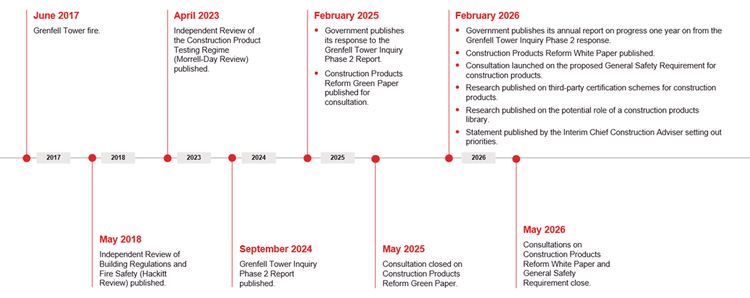
In February 2026, a package of policy papers, consultations and research reports were published with a view to advancing the UK’s programme of building safety reform following the Grenfell Tower Inquiry.
-
The reforms are intended to strengthen oversight and enforcement, improve confidence in testing and certification arrangements and enhance transparency and accountability across the construction products supply chain.
-
Key publications include:
- The government’s first annual report following Phase 2 of the Grenfell Tower Inquiry (Inquiry), which sets out the progress made towards the implementation of the Inquiry’s recommendations and highlights priority areas where reform is now moving into delivery.
- The Construction Products Reform White Paper, which outlines the government’s long-term vision for reforming the construction products regime, confirming a shift from a regulatory framework historically focussed on removing trade barriers to one where safety is the primary focus.
- A consultation on a proposed General Safety Requirement for construction products, which would bring currently unregulated products within the scope of formal regulatory oversight by imposing baseline safety duties across the construction products supply chain.
- Research report on third-party certification schemes for construction products and the potential role of a construction products library to improve access to reliable, standardised product information.
- A statement from the Interim Chief Construction Adviser, outlining priorities for advancing construction product reform, improving standards and professional competence and strengthening the evidence base underpinning building safety regulation.
-
Taken together, these developments signal a clear shift from policy development to regulatory implementation.
-
This article summarises the most significant recent developments and outlines what they mean for manufacturers, suppliers, developers and others operating within the construction and building safety landscape.
Progress on implementing the Phase 2 Grenfell Tower Inquiry recommendations
The government’s first annual report following its response to the Grenfell Tower Inquiry Phase 2 Report (Annual Report) records steady progress on the implementation of accepted recommendations. Of 61 recommendations (including residual recommendations from phase 1), 12 are complete and 49 are in progress. More than half are expected to be complete by the end of 2026.
Key areas of progress identified in the Annual Report include the:
- Establishment of the Building Safety Regulator (BSR) as a separate legal entity in January 2026, moving from the Health and Safety Executive to an arm’s‑length body under the Ministry of Housing, Communities and Local Government. The government’s response to a recent consultation relating to the design of the BSR, including where responsibilities will sit, how functions will be integrated and what legislative changes will be required, is expected in summer 2026.
- Appointment of an Interim Chief Construction Adviser (CCA) to support reform efforts by providing independent expert advice on construction, building safety and regulatory reform and technical standards. The CCA will be replaced by a permanent role at the end of September 2026, being the Chief Construction & Scientific Adviser.
- Publication of the Construction Products Reform White Paper with a parallel General Safety Requirement (GSR) consultation, as a precursor to secondary legislation being tabled in 2026.
- Improvement of professional standards across construction, fire engineering and risk assessment and building control through the introduction of new technical advice and competency frameworks.
- Capacity building and enforcement support for local regulators, with local regulators issuing 124% more formal notices and undertaking 140% more inspections compared to the previous year.
- Reform of consumer regulation in social housing, strengthening routes for resident feedback and expanded resident training and support. Regulations relating to Personal Emergency Evacuation Plans will enter into force in April 2026.
The Construction Products Reform White Paper
The open consultation, the Construction Products Reform White Paper (White Paper), sets out a comprehensive programme of reform to respond to the systemic weaknesses and recommendations identified by the Grenfell Tower Inquiry and subsequent independent reviews.
It provides that the government’s reform agenda will be structured around the following key pillars:
- Risk-based General Safety Requirements for products not covered by designated standards.
- Strengthening assurance, testing and certification, including enhanced oversight of conformity and assessment bodies and clearer expectations around third-party certification.
- Improving product information, traceability and digitalisation, with an emphasis on ensuring that those using products can access clear, accurate and reliable safety information.
- Enhancing enforcement and accountability, by equipping regulators with stronger investigatory and sanctioning powers and embedding clearer responsibilities across the construction products supply chain.
Proposed General Safety Requirement for construction products
Alongside the White Paper, the government has launched a consultation on a proposed General Safety Requirement (GSR) for construction products. This proposes the introduction of a baseline safety obligation for products that are not currently covered by designated standards or technical assessments – which is estimated to be a third of construction products.
The GSR proposals include:
- Mandatory risk assessment: The level of assessment, documentation and mitigation required would depend on the risks associated with a product’s intended and reasonably foreseeable conditions of use.
- Product information: Clear and accurate information must be provided, including detailing intended use, technical specification, installation guidance, safety warnings and restrictions of use. Marketing claims about safety must be based on evidence.
- Labelling and traceability: Products must carry unique identifiers, manufacturer and importer details, supported by digital solution (namely QR codes) to enable traceability.
- Record keeping: Manufacturers and importers must retain risk assessments, product documentation and safety incident records for 10 years to support enforcement.
- Storage and transportation: Actors who fall within the definition of “economic operator” must ensure construction products are stored and transported in ways that maintain their safety and integrity.
- Obligations for importers, distributors and merchants: These actors must verify compliance, maintain records and implement controls to prevent unsafe products from entering the market.
- Monitoring safety issues: Actors who fall within the definition of “economic operator” must monitor products to address safety risks, investigate and record complaints, and take corrective actions (such as amending information or withdrawing unsafe products from the market).
The GSR would operate alongside the existing construction products regulatory regime, rather than replacing it. Products would either fall within a designated standard, or within the GSR, but not both. Enforcement would sit with the national construction products regulator and local trading standards authorities, supported by enhanced investigatory and sanctioning powers. Proposed penalties for breach of the GSR include civil monetary penalties, cost recovery provisions and criminal offences in the case of serious breaches.
Third-party certification schemes
To support proposals in the White Paper, the government published a research report on voluntary third-party certification schemes for construction products. The research identifies significant variation between schemes in terms of transparency, scope and structure. It also found that third party certification is more common for products considered to have lower safety risks or where there are clear regulatory, warranty or insurance-driven incentives.
To address the issues identified in the research, the White Paper proposes to maintain the existing approval regime for third party product certification schemes regulated by the Construction Products Regulations 2013 and used in the UK, coupled with UK Accreditation Service (UKAS) accreditation requirements for every conformity assessment body (CAB) that carries out testing, inspection or certification for construction products. This would require scheme owners to meet minimum transparency requirements and ensure certificates are supported by evidence, such as test results where appropriate. CABs would also be brought within a statutory licensing code requiring them to act in the public interest.
Product information, digitalisation and the construction products "library"
The February 2026 publications also address concerns about access to reliable product information. The White Paper confirms the government's ambition to improve the quality, accessibility and transparency of construction product information, including through the use of digital tools. A research paper exploring the potential role of a construction products "library" has been published to support this ambition.
The White Paper contemplates that the "library" may contain:
- Information on approved schemes;
- Safety test results;
- Fire Safety and academic reports; and
- Detailed product information necessary to select and use products that are safe for the planned use.
Statement from the Interim Chief Construction Adviser
The Interim Chief Construction Adviser (ICCA) is a Minister‑appointed, independent adviser within the Ministry of Housing, Communities and Local Government (MHCLG). The role was recommended by the Grenfell inquiry and has since been established to provide independent challenge, scrutiny and advice to the government on building safety reform. Appointed on 30 September 2025, the ICCA, Thouria Istephan, is working to an agreed set of priorities with the Building Safety Minister and engaging widely across industry to inform policy.
A statement published on 25 February 2026 stated that Ms Istephan’s priorities for her term are:
- The reform of regulations for construction products;
- Standards for construction buildings and professionals involved in construction;
- How evidence is gathered and learning from near misses; and
- Supporting the development of a permanent CCSA role.
Ms Istephan’s term will come to an end in September 2026, at which time she will provide a report outlining the work she has done and hand over to a permanent Chief Construction & Scientific Adviser (CCSA), for which recruitment is underway.
Next steps
The White Paper envisages a phased implementation of reforms, with consultation on the design of the GSR running through Spring 2026, secondary legislation expected to follow, and further guidance and regulatory measures to be developed progressively through 2026 and beyond.
Key takeaways for industry
Recent policy developments point to a significantly more robust and safety‑focused regulatory regime for construction products, with practical implications across the construction supply chain. Industry can prepare for the reforms now by:
- Reviewing product portfolios and supply chains to identify products that may fall outside existing designated standards and could be brought within scope of the GSR;
- Strengthening internal product governance and documentation, including risk assessments, testing records and product information, to ensure safety claims can be substantiated;
- Assessing reliance on voluntary third-party certification schemes; and
- Monitoring proposed reforms, consultation outcomes and implementation timelines, as secondary legislation and guidance are expected to follow.
Building safety policy and reforms timeline