Information correct as of 23 March 2026.
Focus on UK: Market overview
The UK remains a world leader in offshore wind, accounting for roughly 20 percent of global offshore wind capacity, with roughly 16.6 GW currently operational and further 11.7 GW under construction. It is forecast that fully commissioned capacity will rise to 36.8 GW by the end of 2030. The UK Government has consistently signalled its continuing intention to bring forward more offshore wind, pledging to achieve at least 43 GW by 2030 to meet the target for net-zero greenhouse gas emissions by 2050 under the Climate Change Act 2008. The Scottish Government recently reset its offshore wind ambitions by increasing its target to 40GW of new capacity by 2040, a significant increase in the previous target of 8-11GW by 2030. Scenarios published by the Committee on Climate Change estimate that at least 75 GW of offshore wind could be needed to meet this target.
A 2025 report from Offshore Energies UK warned that the UK would fail to meet its 2050 net-zero goal without action taken to address price inflation, capital costs, and UK supply chain competitiveness. The same report noted that the seventh contracts for difference allocation round (AR7) would be a key indicator of the market’s appetite in this area, noting it would have to be the “biggest ever”, awarding 8.4GW of capacity, for the UK to stay on track for the above goals. As announced in January 2026, 8.4GW of additional capacity was indeed awarded in AR7, representing over £22 billion of private investment across 12 projects and unlocking more than 7,000 jobs.
The UK’s offshore wind goals align with its neighbours across Europe, as evidenced by the Hamburg Declaration signed in January 2026. This deal between European countries, including Germany, Norway, France and Denmark, is an agreement to deliver 100 GW off offshore wind power through joint clean-energy projects. This is a step towards various North Sea countries’ aim to build 300GW of offshore wind capacity in the North Sea by 2050.
UK: Proposed projects
In addition to the projects outlined above, the UK is planning to significantly expand its offshore wind capacity over the next decade. There are currently more than 11GW of offshore wind projects in the construction phase, with a further 33GW consented through to 2033.
UK: Development process overview (England & Wales)
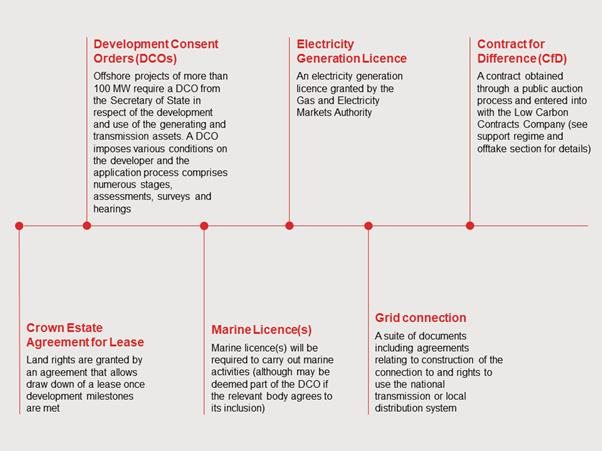
From a real estate, regulatory and consenting perspective, the key development milestones for a UK offshore wind project are set out below.
UK: New Leasing opportunities
The Crown Estate Offshore Leasing
As managers of the seabed around England, Wales and Northern Ireland, The Crown Estate launched Round 5 of its Offshore Wind Leasing programme in February 2024. In contrast to the previous Round 4, this round has specifically focused on floating wind in the Celtic Sea (off the coasts of South Wales and South West England). Following the successful allocation of 8 GW of potential new offshore wind capacity across six projects for Round 4, The Crown Estate has awarded 4.5 GW of new capacity across three projects for Round 5.
In June 2025 it was announced that two of these three projects would likely be taken forward by Equinor and Gwynt Gas (a joint venture between EDF Renewables and ESB). This was followed by an announcement in November 2025 that rights to the third floating offshore wind project that makes up Round 5 are set to be awarded to Ocean Winds (a joint venture between EDPR and Engie).
For further information, please refer to the section on floating offshore wind.
The Crown Estate Scotland Offshore Leasing
In January 2022, Crown Estate Scotland offered 17 projects option agreements under its ScotWind programme, the first round of offshore wind leasing in Scottish waters for a decade. The total number of projects later increased to 20, although last year the developer relinquished its lease for the Campion Wind site. With the addition of new projects and an increase in capacity of two of the original 17 projects, the total capacity of the ScotWind round has now increased to approximately 30GW.
The majority of these sites plan to deploy the latest floating offshore wind (FLOW) technologies, signalling a significant step forward for the industry. For further information, please refer to the section on floating offshore wind.
On 30 May 2025 the Scottish Government released a draft updated Sectoral Marine Plan for Offshore Wind Energy (SPM-OWE) which sets out an integrated spatial planning framework for both the ScotWind and Innovation and Targeted Oil and Gas (INTOG) leasing rounds, and is designed to better consider potential opportunities and constraints associated with the increased generating capacities awarded for the ScotWind leasing round. This updated draft revised the baseline from the 2020 version of the SPM-OWE in response to the increased interest, and more ambitious aims, for offshore wind development in Scottish waters arising from the ScotWind leasing round. The Scottish Government opened a consultation on the SPM-OWE which closed in August 2025. The consultation process raised various concerns within industry, including risks of prioritising further T&D sites over existing ScotWind and INTOG sites. The SPM-OWE is under going further revisions to take into account the outcome of the consultation process.
UK: Offtake support regimes
The primary support scheme for offshore wind in the UK is the Contract for Difference (CfD) scheme, which replaced the previous Renewables Obligation (RO) scheme.
The CfD scheme is, in essence, a power price hedge to pay or be paid the difference between a notional market reference price for electricity and a bid “strike price.” This can lead to the generator receiving payments from or having to make a payment to, the Low Carbon Contracts Company, which has been operational since 2014 and was designated as the CfD Counterparty under the Energy Act 2013. Generators sell power separately under a power purchase agreement (PPA).
Since the full implementation of the CfD regime, there have been seven competitive auction rounds to award CfDs concluding in 2015, 2017, 2019, 2022, 2023, 2024 and2025. From March 2023, the UK Government increased the frequency of CfD auctions to every year (rather than every two years).
Allocation Round (AR) 1, saw CfDs awarded to two offshore wind projects with a combined capacity of 1.16 GW at an average price of £117.14/MWh
AR 2 saw 3.1 GW of offshore wind awarded CfDs, with prices ranging from £74.75/MWh for projects commissioning in the 2021/22 delivery year and reducing to £57.50/MWh for the 2022/23 delivery year.
AR 3 saw 5.46 GWs of offshore wind offered CfDs. The round saw the first “zero monetary budget impact” bids, with strike prices below wholesale power prices at £39.65/MWh for delivery in 2023/24 and £41.611/MWh for delivery in 2024/251.
AR 4 saw offshore wind being given its own separate pot of budget for the first time, resulting in almost 7 GWs of new offshore wind projects being awarded CfDs. The per unit price of offshore wind secured has continued to decline, with successful projects securing a strike price of £37.35 per MWh for delivery in 2026/27. A capacity cap was also introduced to maintain competitive tension.
AR5 saw offshore wind sit in Pot 1, alongside solar and onshore wind. For the first time since the inception of the CfD scheme, not a single megawatt of offshore wind secured government support under the CfD regime. Whilst a disappointment for the sector, the outcome did not come as a surprise to many in the industry.
The outcome of AR5 confirmed that prices available to UK projects under the UK Government’s CfD regime were insufficient to absorb the impact of rising interest rates, supply chain constraints and spiralling inflation which are collectively squeezing margins across the industry. As a consequence, it became clear that some developers were reconsidering the attractiveness of investing in a fully CfD-backed project. Developers’ decisions to not take an investment decision to proceed with the development of various offshore wind projects highlighted the practical realities of the cost crisis that were facing the UK offshore wind sector.
Ahead of AR6, in April 2023, the UK Government announced a call for evidence on its plan to introduce non-price factors as part of the CfD assessment criteria. This development highlighted a re-prioritisation by Government beyond a “price-alone” focus, to ensure that other factors such as capacity, sustainability, innovation and system flexibility, are also appropriately accounted for by the CfD. The hope was that these changes could assist future projects to deal with the multitude of disruptive trends affecting offshore wind project development globally.
In November 2023, the UK Government released the strike prices for AR6, together with for the first time ever, the comprehensive methodology used to determine the strike prices. The methodology note set out the UK Government’s objectives, approach and assumptions to setting strike prices. Chief among the factors considered were:
- technology specific factors such as capital and operating costs, financing costs as well as any build constraints;
- market conditions such as estimated wholesale electricity prices and the discount which generators may face when signing a Power Purchase Agreement (PPA); and
- policy considerations such as the statutory purpose of the scheme to encourage low carbon electricity generation and the need to have regard to meet Carbon Budget 6 (CB6) and Net Zero targets, the likely cost to consumers, and ensuring security of supply.
The UK Government also introduced a risk premium for offshore wind technologies, applied as an addition to the hurdle rate. The Department for Energy Security and Net Zero (DESNZ) considered that the combination of cost uncertainty, complex supply chains, lack of capacity and limited price discovery secured through AR 5, as well as transmission network use of system charges (TNUoS) uncertainty warranted a risk premium of 2% be added to the hurdle rates of fixed and floating offshore wind. Accordingly, the hurdle rate with the added risk premium was set at 9.8% for FLOW and 8.33% for fixed offshore wind. The UK Government stated at the time that this “… will allow room for future price movements until project costs are secured” and support the ambition for the strike price “… to act as a backstop for the auction rather than a significant constraint on participation”.
The UK Government also made some changes to the CfD standard terms and conditions and private network CfD agreement ahead of AR6 ,including:
- Making generators that directly supply offshore oil and gas facilities ineligible for AR6;
- Strengthening generators “know your customer” requirements; and
- Providing flexibility to the Milestone Delivery Date where a generator has not received confirmation from the Ministry of Defence of the availability of suitable mitigation measures in relation to interference between windfarms and air defence radar systems.
AR6 saw technologies grouped between 3 distinct pots, with FLOW comprising part of Pot 2 and all other Offshore Wind generally forming Pot 3. In structuring Pot 3, the UK Government also acknowledged the fact that there was a mixture of projects bidding into AR6 and as such, Pot 3 was split between Offshore Wind Permitted Reduction projects and new Offshore Wind projects. Offshore Wind Permitted Reduction projects are those projects that had secured a CfD in a previous AR, but have since elected to reduce the capacity under such CfD by up to 25% in order to permit that project to re-bid into AR6, for example owing to the economic limitations of the strike prices achieved in previous ARs in the context of the current market environment.
On 31 July 2024, the UK Government announced an increase of £500million to the AR6 budget, taking the total funding allocation to £1.5bn; 7 times that of the AR5 budget. A total of £1.1bn was allocated for offshore wind, a £300million uplift and the largest increase for any of the sectors of AR6.
The results of AR6 were announced on 3 September 2024 and projects with an aggregate capacity of approximately 5GW were awarded a CfD. This was a considerable success for the sector and DESNZ, with the 400MW Green Volt project securing the first CfD for a commercial scale FLOW project. However, 1.6GW of this capacity was for Offshore Wind Permitted Reduction projects, increasing their previous strike prices from £37.35/MWh to £54.23/MWh (both 2012 prices), which means that this was not ‘new’ capacity. It should be noted that Permitted Reductions were not eligible to bid in AR7, and there is currently an ongoing consultation for AR8 to make this restriction permanent.
Although the AR6 results were an improvement on AR5, they placed further pressure on AR7 in order to meet the UK’s clean energy goals. Energy UK have previously estimated that the AR6 and AR7 CfD auctions would together need to secure 21GW of new offshore wind capacity for the UK in order to reach the target of 50GW of offshore wind capacity by 2030, which despite being increased in the interim to a pledge of 60GW, has since been revised down to a target of 43-50GW.
On 18 October 2024, further changes to the CfD auction ahead of AR7 were announced and, following a consultation with industry in early 2025, were implemented for AR7 via secondary legislation. The majority of the amendments were focused on repowering, FLOW, an extension to the CfD term from 15 to 20 years, and changes to metering. In terms of impact on offshore wind, some of the key outcomes are perhaps certain changes that were not made for AR7:
- hybrid metering was not introduced, and any future amendments will be evaluated based on broader market developments;
- no changes were made to support improved coordination of offshore transmission infrastructure; and
- no changes to the approach to indexation were made.
Also relevant to AR7 was the introduction of the Clean Industry Bonus (CIB); see further detail below.
As noted above, the results of AR7 have been considered by industry as a resounding success, meeting the goal estimated by OEUK’s 2025 Offshore Wind Insight that it must deliver 8.4GW of new offshore wind capacity in order to keep the UK on track for CP30 goals. The budget of £1.79bn, double the previous budget, was allocated across 10 fixed-bottom projects and 2 floating projects, with a record 19 projects being eligible to bid. Highlights from the project list include Berwick Bank, set to be the largest offshore wind project in the world, and Awel Y Môr, the first Welsh project to win a contract in over a decade.
The level of competition resulted in strike prices for AR 7 which compare favourably with alternative power sources; fixed bottom offshore wind the strike price is £91.20/MWh for England and Wales and £89.49/MWh for Scotland, at a blended average of £90.91/MWh. The strike price for floating offshore wind is £216.46/MWh. These prices are around 40% lower than building and operating new gas plants, and almost 30% lower than building and operating new nuclear plants.
The strong AR7 results have been hailed by many as a significant milestone in the UK’s energy security for the future, representing the largest single award of subsidy support for offshore wind in British history according to UK Government statistics. Looking forward to AR8, the UK Government is currently considering the results of a consultation designed to improve investor confidence in the CfD mechanism. This includes retaining the restriction on Permitted Reductions re-bidding into future allocation rounds introduced in AR7, similarly retaining (and expanding to other technologies) the Secretary of State’s ability to view sealed bids anonymously and excluding Gate 1 connection offers.
UK: Hot topics
Revenue stacking
Innovative offtake strategies are increasingly being implemented by developers in order to improve the internal rate of return for their projects, having regard to the cost-related challenges that have faced the development of offshore wind projects in recent years.
To this end, revenue stacking models are increasingly being implemented in the offshore wind sector, with developers taking advantage of “stacking” corporate power purchase revenue streams with CfDs, and in some cases also adding merchant revenues and co-location (such as with energy storage systems) to their revenue mix.
For more information please see our detailed article on revenue stacking in the context of fixed-bottom offshore wind.
Floating offshore wind (FLOW)
The development of the FLOW sector is gathering pace. The GreenVolt floating offshore wind project was successful in its AR6 bid, succeeding with a £139.93/MWh (2012 prices) strike price bid for 400MW capacity, and the Pentland and Erebus floating offshore wind projects secured CfDs in AR7 at a strike price of £216.46/MWh (2024 prices). This is good news for the sector and there are hopes that these first projects will help pave the way for the rest of the FLOW industry in the UK.
For more information please see the section on floating offshore wind.
Chinese OEMS and the supply chain
Owing largely to the severe supply chain constraints faced by the offshore wind sector as a whole, there is an increasing focus on finding alternative equipment solutions. One such option is to turn to Chinese original equipment manufacturers (Chinese OEMs) where there has previously been reticence to do so in the UK (and wider European) market.
The leading Chinese OEM, Goldwind, reported in June 2025 that it had reached 881.49 MW of wind-turbine capacity across Europe, and continues to dominate the global rankings of wind turbine makers alongside other Chinese OEMs. However, the Chinese OEMs are heavily reliant on their home markets and the vast majority of their projects are onshore.
There is speculation that this reliance may slowly evolve however; in 2025 there was a record 66% increase in Chinese OEM orders from outside of China for wind turbines, more than triple the figures seen in 2023. There are various prevailing concerns in the market with Chinese technology, particularly regarding their track record, likely life expectancy, and possible environmental and/or social impacts (including compliance with EU emission and other ESG standards), as well as national security concerns. Despite this, the continued pressure on the supply chain and the potential cost benefits of using Chinese OEMs is generating momentum for the adoption of Chinese OEM technology in the UK and European offshore wind sector.
The UK Government is currently considering whether to approve Mingyang’s proposal to build a £1.5bn turbine manufacturing facility in Scotland which, if approved, could unlock further incorporation of Chinese OEM technology and investment into UK offshore wind. A decision has not yet been reached, which is delaying developer clarity on its supply chain, likely having a knock-on impact for investors that require great certainty in order to take an investment decision, commit capital and agree construction timelines.
The market continues to pay close attention to how this develops, and we are seeing detailed bankability analysis being commissioned by sponsors and lenders alike to assess the viability of using Chinese OEMs for future offshore wind projects in the UK and Europe.
Spotlight on OFTOs, shared infrastructure and changes to Anticipatory Investment
In the UK, the offshore transmission owners (OFTOs) are responsible for offshore transmission assets. Whilst in theory OFTOs may design and build offshore wind connections, in practice offshore wind farm developers have always elected to build the link themselves, in order to mitigate the risk of non-delivery of the connection assets. After commercial operations start, the transmission assets are then sold to the selected OFTO. However, developers are often keen to provide the operations and maintenance services in respect of the OFTO assets to ensure availability standards are met (particularly as no direct compensation is payable by the OFTO to the wind farm in the event of a connection outage).
While placing responsibility for the development of offshore transmission into the hands of generating asset developers has assisted with the rollout of offshore wind capacity in the UK, the limitations posed by the onshore grid remains a key issue for developers and investors and should also be a key focus for the UK Government. Ever -increasing cost pressures are pushing developers to find new ways to mitigate their capital costs. This includes absorbing operation and maintenance services and creating shared servicing hubs and infrastructure platforms to support the construction, operation and maintenance of co-located projects.
The UK Government is also concerned about the constraints of the current offshore transmission infrastructure on offshore wind capacity, especially with rising transmission network use of system charges (TNUoS). Various development stage offshore wind projects have sited uncertainty around TNUoS as potentially limiting the ability to progress in AR8. Shared offshore transmission infrastructure is another potential way in which to reduce these costs, which comes with its own considerations.
In July 2023, the UK Government released recommendations from the Offshore Transmission Network Review (OTNR), highlighting the need for a new approach to support the UK's decarbonisation and net-zero objectives.
In December 2024, Ofgem announced its intention to shift from the late OFTO build model to an early competition OFTO build model. Ofgem then opened a lengthy consultation process with stakeholders regarding the regime, specifically exploring:
- the policy framework for extension to OFTO revenue streams;
- the most appropriate licence term duration relevant to the technical life of OFTO assets; and
- potential options for improving the efficiency of tender process were the generator commissioning clause to be extended.
The consultation closed on 9 September 2025, with results published in December 2025. The key decisions made were:
- The 98% availability target for OFTO assets, including the “vast majority” of high voltage direct current (HVDC) assets, has been maintained. However, a reduced target may be accepted for some HVDC projects where developers have presented a pre-tender convincing business case regarding the need for a departure (for example, owing to technical characteristics such as having over 200km of cable). Any reductions agreed from the 98% target would be reflected in the reward/penalty structure for such projects.
- There has been a recalibration of the OFTO process in terms of timing and milestones to make use of the extension of the Generator Commissioning Clause period from 18 to 27 months. The proposed new process and timeline is outlined in the diagram below provided by Ofgem. It has been stressed by the regulator that the reforms are intended to increase efficiency and “support smoother transactions”.
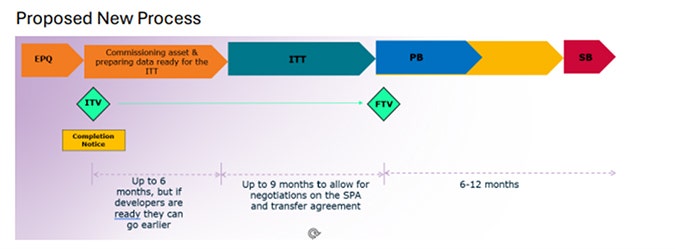
Credit: Further evolution of the OFTO Regime.
Key:
- EPQ: enhanced pre-qualification; this is the first formal stage of an Ofgem OFTO tender, at which Ofgem assesses the potential bidders to determine who is eligible to proceed.
- ITV: indicative transfer value; this is the mid stage valuation of the OFTO assets as calculated by Ofgem and used to inform the provisional cost position for all stakeholders.
- ITT: invitation to tender; at this stage the eligible bidders submit detailed commercial and technical bids to demonstrate the competitiveness of their proposals.
- FTV: final transfer value; this is the ultimate binding value used in the asset transfer documentation.
- PB: preferred bidder; this is the successful bidder selected at the end of the ITT stage to take forward exclusive negotiations with the developer and to work with Ofgem to meet regulatory requirements for eventual license granting / asset transfer.
- SPA: sale purchase agreement; this is the key legal document governing the sale of the OFTO assets themselves.
Some issues, particularly to address the increased prominence of HVDC projects, were reserved for discussion as part of future consultation processes. A new consultation was launched in February 2026, hot on the heels of conclusion of the above round, focussed on reimbursement of costs for the EPQ round, ‘passporting’ of EPQ status across rounds, more qualitative criteria in bid assessments, and management of tender rounds with over 4 assets.
As an increasing number of offshore wind projects reach the OFTO stage it is expected that further refinements will be made to the processes, using such consultations as guidance.
UK Policy developments
Energy Act 2023
The Energy Act 2023 (the Act) received Royal Assent on 26 October 2023. Key aspects of the Act that impact the offshore wind include:
- amendments to the Electricity Act 1989 to introduce multi-purpose interconnectors (MPIs) as a licensable activity, providing certainty to investors and developers and aiding the integration of renewable energy, such as offshore wind, onto the grid.
- the Act incorporates the policy proposals of the new Offshore Wind Environmental Improvement Package (OWEIP), aimed at speeding up offshore wind deployment while protecting the marine environment. This includes new powers to amend the HRA process for marine aspects of offshore wind projects, thereby accelerating the consenting process.
- the Act introduces strategic compensatory measures, facilitating collaboration between developers and the UK Government to address unavoidable environmental impacts. An industry-funded Marine Recovery Fund (MRF) will support these measures, though it has yet to become operational.
For more information on the Act and its implications for the offshore wind sector see: UK Energy Act 2023: Environmental commitments for offshore wind.
Energy and Crown Estate Partnership
On 25 July 2024, the UK Government introduced the Great British Energy Bill into Parliament to enable the establishment of GB Energy, the UK Government’s new publicly owned ‘clean energy superpower’. The UK Government is providing GB Energy with £8.3bn of funding but is looking to raise a further £60bn of private investment.
On the same day, GB Energy’s first strategic partnership was announced with The Crown Estate. The new partnership aims to accelerate the delivery of clean energy infrastructure and boost the UK’s offshore wind sector, claiming to lead to up to 20GW-30GW of new offshore wind developments securing seabed leases by 2030. Since then, GB Energy (alongside NWF and SNIB) have provided backing to the Pentland floating offshore wind project in Scotland and developed a strategic plan to (i) transform local energy; (ii) invest strategically in onshore assets and (iii) boost jobs and growth in Scotland the Celtic Sea for offshore wind.
Alongside the announcement, the UK Government also proposed a new Crown Estate Bill, which received Royal Assent on 11 March 2025. Under this new law the Crown Estate receives new borrowing powers, aimed at boosting investment in preparing its seabeds for offshore wind and other projects. This includes the ability to borrow capital and invest more flexibility.
Proposed Planning reform
In July 2024, it was announced in the Kings Speech that a new Planning and Infrastructure Bill (the “Bill”) would be introduced. The Bill was published on 11 March 2025 and is wide reaching beyond the energy sector, but amongst its aims, it looks to streamline the planning process for major energy projects, including upgrading the national grid and boosting renewable energy, such as offshore wind. The Bill is part of a broader effort to address some of the key challenges faced by the offshore wind sector. The key 5 goals of the Bill, as outlined by the UK Government, are:
- Delivering a faster and more certain consenting process for critical infrastructure.
- Introducing a more strategic approach to nature recovery.
- Improving certainty and decision-making in the planning system.
- Unlocking land and securing public value for large scale investment.
- Introducing effective new mechanisms for cross-boundary strategic planning.
Spotlight on Clean Industry Bonus (CIB)
For AR7, the UK Government implemented a non-price related support package known as the Clean Industry Bonus (CIB). The CIB is an additional funding pot which has (currently) been made available to fixed and floating offshore wind projects, and the submission of a CIB Statement was a mandatory step in order to qualify for AR7.
When first announced, the CIB was referred to as the CfD Sustainable Industry Rewards (SIRs) (and is referred to as such in the applicable legislation and documentation), however the scheme has evolved and is now known as the CIB.
The CIB aims to address recent supply chain challenges that have been hindering the deployment of offshore wind by providing additional revenue support to developers, through a series of lump-sum payments in addition to their regular CfD payments, should they invest in the economic, social, and environmental sustainability of their supply chains. The criterion for such investments is ‘investment in shorter supply chains’, ‘investment in more sustainable means of production’ and ‘investment in shorter supply chains that use more sustainable means of production’.
Like the CfD regime, CIBs will be awarded through a competitive auction. Developers will submit proposals in pursuit of the sustainability criteria the UK Government is offering support for and will compete against each other on the quality and cost of their proposals. The CIB allocation framework (first published in November 2024 and subsequently amended in January 2025) set the minimum standard value to participate in the AR7 auction as £100m per GW for a fixed bottom offshore wind project and £50m per GW for a FLOW project.
The first CIB allocation round ran from 13 February 2025 until 14 April 2025, ultimately awarding £204 million in investment (subject to final approvals). On 7 May 2025 the UK Government announced that the budget applicable for the CIB for AR7 was £20.1 million per GW of capacity, amounting to a total budget of over £544 million. A portion of the CIB budget is specifically ring-fenced for FLOW proposals, and termed a ‘sub-budget’. The value of this ring-fenced portion has not been, and will not be, disclosed.
The UK Government confirmed that the CIB will also apply to AR 8 and AR 9, and in February 2026 announced amendments to the CIB for future allocation rounds following consultations, with some key highlights as follows:
- Signing up to the interim ‘Fair Work Charter’, which is “a tripartite agreement that provides a commitment to high quality jobs in offshore wind”, will be a minimum standard for applicants to the CIB for AR 8. A final version of the charter will be agreed in due course and applicable to AR 9, with both the interim and final charter being the result of negotiations / input from the offshore wind industry and trade unions.
- Developers will be encouraged, and incentivised through the CIB, to contribute to one central and collaborative ‘skills investment fund’, to fund a variety of eligible skills activities such as apprenticeships, STEM engagement, and virtual work experience for hard-to-reach areas. The intention is to consider how this will be administered more thoroughly, with a view to having the fund operational in 2027.
- The CIB will be extended to onshore wind, however this will not be implemented until AR 9. It was determined that the applicable minimum standard will be £25m/GW, with such lower threshold reflecting the differences between offshore and onshore wind in terms of supply chain maturity and project size.
- Process and regulation refinements to the CIB will be introduced for AR 8, including more flexibility in budget-setting and amendments to the statutory timelines to enable AR 8 to “run in a timely manner”. Developers will also be able to receive CIB payments earlier than was applicable on AR 7, on a ‘pay on delivery’ basis. Payments will be able to be made as soon as investments towards minimum standards and CIB extra proposals have been made. This is intended to improve financing and reduce capital pressure.
UK short-term investor outlook
Notwithstanding the challenges faced by the offshore wind industry domestically and globally in recent years, the market outlook for the UK is optimistic and there is a sense of renewed optimism in light of the record-breaking AR7. Significant developers such as SSE, Equinor, Ocean Winds and RWE continue to signal their commitment to the sector, and whilst politicians are increasingly taking differing views on UK offshore wind, the current UK Government remains supportive of the sector domestically and internationally. This sentiment has only been strengthened by new investment initiatives such as the creation of GB Energy and the Crown Estate partnership. Despite the political headwinds, developers and investors are continuing to seek increasing exposure to the UK offshore wind market over the short, medium and long term.
Consented projects continue to rely on the CfD regime for revenue support, which remains a key tenet of the bankability case for projects to avail themselves of project financing. That being said, more flexible financing structures and revenue stacks (including corporate PPAs) are being actively pursued and implemented, particularly in light of prevailing uncertainties regarding inflation, electricity prices and supply chain constraints.
There are also significant M&A opportunities for investors. Given the increased upfront costs faced by projects during the development phase, the appetite for joint venturing and pre-FID divestment is strong. This has also been influenced by the scale of projects (including FLOW) approved by the Crown Estate Scotland, as in certain cases, the targeted size of these projects will almost certainly require pre-FID divestment. M&A activity in operational projects also remains very strong, as many of the major developers continue to seek to divest offshore wind assets, moving to a ‘utility light’ model by recycling these sales proceeds into future projects. Supply-chain constraints are also driving market participants to form strategic partnerships in order to manage supply-related risk, as well as create efficiencies and economies of scale.
In addition, a number of projects have applied and/or secured rights to extend their existing projects. We have already seen a number of these projects seek additional investment and financing to fund development works and we expect similar opportunities of this nature to come to market.
A relatively new feature of the investment landscape in UK offshore wind is the increasing prevalence of “structured equity” as a means to finance significant, capital-intensive offshore wind projects. Used predominantly by private equity funds as a hybrid finance option (featuring elements of both debt and equity), it provides developers with a new source of equity capital from with relatively new-entrant funds seeking development-risk upside.
Finally, looking ahead to AR8 and subsequent allocation rounds, to shore-up confidence in the allocation round system and investment in early-stage offshore wind projects more generally, a key challenge for the UK Government will be to ensure that bidding projects are given a clearer indication of their chances of success at an earlier stage in the process so as to avoid surprise outcomes (as we saw as part of AR7).
Our recent work highlights include: