This article was co-authored with Jennifer Meek, Carty Chan, and Anisa Sakhi.
The Australian Government has released draft legislation that proposes to materially reshape the capital gains tax (CGT) regime for foreign residents by:
- broadening the scope of taxable assets;
- extending testing periods;
- introducing new compliance obligations; and
- significantly tightening the foreign-resident capital gains withholding (FRCGW) regime.
For investors in the renewable energy sector, the proposed reforms are particularly acute: an expanded and retrospective definition of real property that will significantly increase their tax base, whilst a proposed 50 percent CGT discount operates prospectively and is subject to eligibility constraints that may exclude many integrated projects.
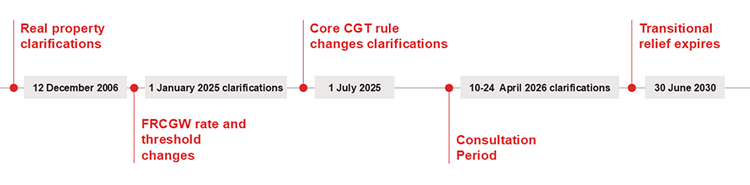
Consultation on the exposure draft closes on 24 April 2026.
Proposed changes at a glance
Scope and testing
‘Foreign residents’ will be subject to CGT on both direct and indirect disposals of an expanded scope of real property that will capture assets with a close economic connection to Australian land and natural resources. Reliance on state-law “severance” concepts will be eliminated, the principal asset test testing period extended, and new ATO notification requirements imposed on certain vendor declarations.
A ‘foreign resident’ is any person that is not a ‘resident’ under the Income Tax Assessment Act 1936 (Cth), which defines a ‘resident’ as either a company which is incorporated in Australia or, if not incorporated in Australia, carries on business in Australia and has either its central management and control in Australia, or its voting power controlled by shareholders who are residents of Australia.
Limited transitional relief for renewable energy assets
A transitional 50 percent CGT discount will be available for eligible foreign resident entities until 30 June 2030 for CGT transactions relating to certain renewable energy related assets.
Foreign-resident capital gains withholding (FRCGW) regime
For certain transactions valued over $50 million, vendors will need to notify the ATO when giving a vendor declaration to a purchaser. The threshold for a purchaser’s reliance on vendor declarations has been increased to an objective test (i.e. reasonably expected to know that the declaration is false) from the previous subjective test (mere knowledge that the declaration is false).
These changes follow earlier amendments, effective from 1 January 2025, which increased the FRCGW rate from 12.5 percent to 15 percent and removed the AU$750,000 de minimis threshold entirely.
| 15% | $50 million | 50% |
| FRCGW withholding rate (up from 12.5%) | Vendor notification obligation for FRCGW | CGT discount for qualifying renewable-energy assets (until June 2030) |
Key dates
The core CGT changes are proposed to apply to CGT events on or after 1 July 2025, with certain “real property” definition amendments operating retrospectively from 2006 (when the current foreign resident CGT scheme commenced). The FRCGW amendments commenced from 1 January 2025.
Impact on foreign investors
The proposed broader asset coverage and extended testing periods mean more foreign investor disposals, including indirect exits, will be taxable in Australia. New ATO notification obligations for vendor declarations on high value transactions will add a further compliance dimension, including the depth of due diligence required to satisfy the higher knowledge threshold, and may affect timelines on transactions involving Australian land-connected assets.
Retrospective application and enforcement risk
The draft legislation responds to recent court decisions which held that certain Australian assets (including electricity transmission infrastructure and mining-related plant) fell outside the scope of “real property” for foreign-resident CGT purposes, and recent cases concerning whether fixed assets that were ‘statutorily severed’ from the land still constituted part of the land for state tax purposes. The explanatory materials state that the ordinary meaning of real property was never intended to be affected by the operation of state and territory laws and present the definitional changes as clarifications to reflect the original policy intent of the foreign resident CGT laws.
The proposed expanded definition of real property represents a material departure from the current law, and would capture assets fixed or installed on land for the majority of their useful life, including wind turbines, solar panels, battery energy storage systems, transmission lines and heavy machinery, irrespective of whether they are fixtures at common law or are ‘statutorily severed’ from the land under state or territory legislative provisions. The expanded definition in relation to fixtures applies retrospectively to CGT events on or after 12 December 2006, meaning transactions completed up to 20 years ago could now fall within scope. In contrast, the expanded definition to things ‘installed’ on land will only apply prospectively if enacted. What constitutes something ‘installed’ on land is unclear – the explanatory notes only suggest that the word ‘installed’ should take its ordinary meaning and encompasses things that are ‘placed in position for use’.
There is no transitional period for the retrospective amendments, and no statutory limitation period for investors who did not lodge Australian tax returns. Combined with the ATO’s access to transaction data through FIRB approvals, this makes retrospective enforcement possible.
The draft legislation includes a treaty override requiring references to “immovable property” or “real property” in Australia’s tax treaties to align with the expanded definition, but this applies only prospectively.
For the period from 2006 to enactment, treaty-resident investors may rely on existing treaty definitions to resist retrospective application, although protection is limited to investors from treaty countries and depends on the asset-holding structure.
Sector focus: Impact on renewable energy investors
For renewable energy investors, the proposed expanded definition of real property will mean that assets such as wind turbines, solar panels and transmission infrastructure, are now within scope of the regime, where they are fixed or installed, or situated on Australian land for the majority of their useful life.
The draft legislation introduces a time-limited 50 percent CGT discount for qualifying disposals until 30 June 2030. However, unlike the expanded real property definition, this discount will only apply prospectively, and does not relieve pre-enactment CGT events. It is also subject to several criteria that further narrow its application, including that the relevant assets have the primary purpose of generating, or directly facilitating the generation of, electricity in Australia using an ‘eligible renewable energy source’. This may include assets which are under construction, temporarily dormant or not yet under construction but genuinely intended to produce electricity from an eligible renewable energy source.
Investors who disposed of renewable interests in good faith reliance on prior guidance that such assets were not “real property” now face full retrospective liability with no concession.
The discount is further constrained by a 90 percent taxable Australian real property (TARP) threshold for indirect disposals, potentially excluding integrated generation-plus-BESS projects where the storage component exceeds 10 percent of TARP value. This may reduce the attractiveness of Australia to foreign capital, particularly infrastructure investors with diversified portfolios, and appears inconsistent with broader policy objectives of accelerating the transition to renewable energy in Australia.
We will keep you updated of developments on these proposed changes.
What this may mean for foreign energy investors
- If legislation is introduced and passed in the form of the exposure draft, these reforms will materially expand Australia's taxing reach over foreign-held energy assets, with retrospective effect to 2006 and no transitional relief for historical disposals.
- The 50 percent CGT discount for renewable energy assets, while a welcome concession, will only apply prospectively and is narrowed by a 90 percent TARP threshold that may exclude integrated projects.
- Foreign energy investors should review their Australian tax positions, assess retrospective exposure, and obtain specialist advice ahead of the final legislation.