






Publication
Legalseas
Our shipping law insights provide legal and market commentary, addressing the key questions and topics of interest to our clients operating in the shipping industry, helping them to effectively manage risk.


Australia | Publication | dezembro 2025
|
Mergers or acquisitions that meet certain turnover thresholds will be required to be notified to the ACCC from 1 January, 2026. ACCC clearance is required before a deal can close. Please seek specific legal advice for your situation as the following is a simplified summary. |
Acquisitions of the following are within scope:
*From 1 April 2026, certain acquisitions must still be notified to the ACCC even though ‘control’ may not be acquired, where an acquisition results in voting power traversing across thresholds of 20 per cent and 50 per cent.
Acquisitions of the following are outside the scope:
Most deals will be subject to the following notification thresholds:
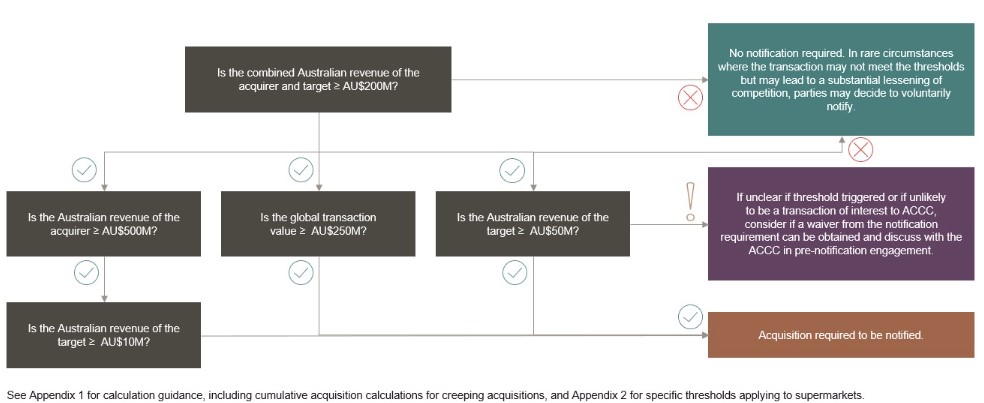
Different thresholds have been introduced for acquisitions that do not comprise all, or substantially all, of the assets of a business (discrete asset acquisitions).
From 1 January 2026 until 31 March 2026, a discrete asset acquisition requires notification if the combined Australian revenue of the acquirer group and target >AU$200m AND the global transaction value is >AU$250m. (For conservatism, we are still keeping an eye on the revenue attributable to the target asset (if any) to assess filing obligations due to some inconsistency between the statutory instrument and the explanatory materials.)
As of 1 April 2026, a discrete asset acquisition requires notification based on decreased global transaction value thresholds:
See Appendix 1 for threshold calculation guidance, and Appendix 2 for specific thresholds applying to supermarkets.
Notifiable acquisitions must not proceed without ACCC clearance or a waiver.
The waiver process is an alternative to notification, not an initial step. Its suitability depends on a careful assessment of the acquisition's complexity and competitive impact.
Waiver applications are best suited for acquisitions that can be quickly assessed based on initial information and:
In contrast, a full form notification is required for acquisitions that clearly meet thresholds and may raise competition issues.
While waivers provide a more cost-effective and streamlined pathway, they still require information on market structure, estimated revenues, commercial rationale and more. If initial waiver application information is insufficient or raises any concerns, the ACCC will reject it. This necessitates beginning again with a full notification and additional filing fee.
Step 1: Pre-notification engagement with the ACCC. Parties are to provide a draft notification application and all transaction documents to allow the ACCC to identify if further information is needed.
Step 2: Parties complete and submit a long or short notification form via the ACCC’s online acquisitions portal.
The long form is required where:
Step 3: The ACCC will confirm the effective notification date (after the filing fee is paid) and the review timeline will begin.
The filing fee to be paid to the ACCC with the notification is predetermined for each stage or pathway.
| Stage | Transaction value (if applicable) | Fee |
| Notification waiver | n/a | AU$8,300 |
| Phase 1 | n/a | AU$56,800 |
| Phase 2 - depending on transaction value | AU $50 million or less | AU$475,000 |
| More than AU $50 million but not more than AU $1 billion | AU$855,000 | |
| More than AU$1 billion | AU$1,595,000 | |
| Public benefits application | n/a | AU$401,000 |
Acquirers that are small businesses, i.e. have less than AU$10 million revenue in the previous financial year, are exempted from paying the fee.
| Phase | Timing |
|---|---|
| Waiver |
The maximum timeframe for the ACCC to complete its assessment is 25 business days. If no determination is made in this time frame, the waiver application will be deemed to be denied. |
|
Pre-notification discussions |
The ACCC will engage ‘promptly and meaningfully’ with businesses once a request is received. The ACCC recommends that parties initiate pre-notification engagement at least two weeks before formal notification and earlier for acquisitions which may raise competition concerns. |
|
Phase 1 |
There will be an initial ‘Phase 1’ review process of 30 business days, from a complete application being lodged. Most deals are expected to clear in this timeframe. There will also be scope for a fast-track determination by the ACCC after 15 business days if no competition issues arise. |
|
Phase 2 |
A ‘Phase 2’ review will be more in-depth and will take up to a further 90 business days. At the end of Phase 2, the merger can be put into effect with or without conditions or disallowed by the ACCC entirely. The ACCC cannot block a merger unless a Phase 2 review has occurred. |
|
Public benefit assessment (+50 further business days) |
From 2026, approval on the basis that there are substantial public benefits that outweigh anti-competitive downsides, is only able to be sought by merger parties if the ACCC blocks the deal in Phase 2. The prescribed period for this review is an additional 50 business days. |
|
Regime promotes timing discipline but the clock can be stopped |
If an ACCC determination is not made within the statutory timeframe for Phase 1 or Phase 2, the acquisition will be deemed approved. This is a significant shift from the current flexible timeframes for reviews in the informal regime that can be varied unilaterally by the ACCC. However, in practice we would expect the ACCC to utilise ‘stop the clock’ mechanisms to extend the statutory timelines thereby providing some flexibility. |
| Post-clearance waiting period | Deals cannot close for 14 calendar days after ACCC clearance occurs to allow any applications for review to be made. |

The approach to calculating revenue and transaction values is similar to that which applies in many jurisdictions.
1. Calculate the Australian revenue of all parties to the transaction
| Each principal entity acquiring control | The target |
|---|---|
|
Australian revenue of the previous financial year of each principal party to the acquisition and each of its ‘connected entities’ (‘acquirer group’). In effect, this looks at the Australian Revenue of the entire corporate group involved in the transaction. |
|
Cumulative acquisitions: In calculating if the target revenue thresholds are met, Australian revenue or assets of the target group need to be considered in combination with that of past acquisitions within the previous three years of target businesses that are predominately active in the same or similar market.
For past acquisitions by the acquirer group Australian revenue is calculated at the time of the respective signing date.
However, the following acquisitions by the acquirer group of previous targets can be disregarded:
2. Consider the transaction value
In measuring a transaction’s value, the greater of the following applies:
3. Notes on revenue and values
While the preceding notification thresholds apply generally across the economy, certain transactions within the supermarket sector must be notified regardless of whether they meet the general notification thresholds and regardless of whether they result in a change in control.
Major supermarkets – Coles and Woolworths (including their connected entities) – must notify the ACCC of acquisitions of shares or assets where they are acquiring:
Specific land acquisitions for supermarket business are exempted from the notification obligation:
Publication
Our shipping law insights provide legal and market commentary, addressing the key questions and topics of interest to our clients operating in the shipping industry, helping them to effectively manage risk.
Subscribe and stay up to date with the latest legal news, information and events . . .
© Norton Rose Fulbright LLP 2026